
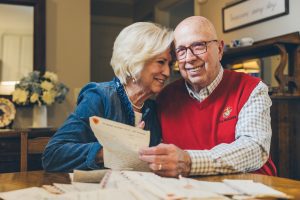
Derl and Marilyn Horn’s friends set them up on a blind date in November 1960. After the high school junior-senior play, they got Cokes and French fries at The Drumstick drive-in near AQ Chicken – and have been together ever since.
They both grew up in Springdale, where Marilyn’s father helped manage her uncle’s lumber company. Marilyn had an older sister and two younger brothers. In high school, she played alto saxophone in band and was in choir and several clubs. Living east of town, with an older brother and two sisters, Derl and his brother played Tarzan and cowboys, swam in the White River, and caught crawdads and minnows in a spring. His parents worked in the poultry industry, and the family eventually moved closer to town.
Derl and Marilyn had become Christians in childhood and were raised in Christian homes. Her parents had saved money for her to attend college, and she completed a year at the University of Arkansas. At that time, Derl expected he’d be drafted for the Vietnam War, and the couple wanted to get married; her parents wanted her to finish college.
“We didn’t know whether to put it off or what because the war was raging and I was at the age,” Derl said. “I was pretty sure I was going to get drafted. I wasn’t anxious about joining, but I was ready to do my part.”
Starting Off, Together and Apart
Marilyn and Derl got engaged the summer of 1962 and wed in November 1963. She was 19, and he was 21. “We wanted to build our lives on our faith, and having a home that represented the Lord well,” Marilyn said. After two years, Derl asked to move his name up on the draft list so he could complete his service sooner.
During the physical and check-in in Little Rock, some Marines asked for five volunteers for the Marine Corps. Derl agreed because his service would last two years – one year less than the Army. But his training in San Diego meant 17 weeks apart from his bride.
The couple spent two months stationed at Camp Lejeune in North Carolina, then Derl served a five-and-a-half-month tour in Cuba before they got two more months together. Then came his orders for Vietnam. While training in El Toro, California, Marilyn called to tell him she was pregnant. “That was hard to deal with, because I’m going off and leaving her and she’s going to have a baby on her own,” he said.
Marilyn saw him off from the Tulsa airport, and they both kept calendars counting down the days to his return. Derl trained for a month in Okinawa, then he and other Marines traveled to Vietnam on a C-130 Hercules. The reality of the war set in for him as they first watched dozens of body bags get unloaded. “We knew that these men had been killed in action, and we knew that probably some of us would be coming back that way. And, sad to say, many did. It was a scary time for me,” he said.
Derl thought they’d crash landed in Da Nang when the plane touched down on metal pieces used to form an airstrip. He was assigned to Bravo Company in the Third Marine Division, 1st Battalion, 9th Marines – known as “The Walking Dead.” An E-3 Lance Corporal, Derl was a 60mm mortar assistant gunner, carrying the tripod for the mortar along with his rifle.
Throughout his service, he and Marilyn regularly exchanged letters. She wrote on the front, and he replied on the back. Their letters and faith sustained them during their greatest moments of fear and uncertainty.
The Jungles of Vietnam
On Derl’s first day out with Bravo Company, June 6, 1967, they crossed an open field. Midway through, a mortar attack began. Shrapnel exploded. Marines pressed their bodies to the ground. None were injured. “That was my first miracle,” he said.
The second day, they walked into a Viet Cong ambush. “We didn’t have anywhere to go other than to fight our way through. And we did,” Derl said. Many Viet Cong were killed, with two captured. Derl prayed, wondering how he’d survive if every day was like that.
At the end of June, in Con Thien, they were assigned to wipe out any enemy or new positions near the demilitarized zone (DMZ) between North Vietnam and South Vietnam. The North Vietnamese army bombed the area daily, and their commander said five battalions of that army had been spotted nearby.
Bravo Company headed out early on July 2. Around 9 a.m., the enemy found them. They were outnumbered by thousands in a U-shaped crossfire ambush. They fought all day and called for support, which arrived around 4 p.m. and helped drive back the enemy. By then, the company’s 150 Marines had dwindled to 26 still standing; 59 had been killed and 65 were wounded.
A grenade that exploded near Derl’s head had filled his ears with shrapnel. And, as he helped evacuate a wounded Marine, mortar fire sent shrapnel into Derl’s left arm. He removed all but three embedded pieces, his “souvenirs.” At one point, he left behind his mortar and backpack filled with letters, Bible, camera, film, food and water and sprinted through a metal hail storm with only his .45 pistol as protection. Ronnie Fields saved Derl’s life that day, killing a North Vietnamese soldier armed with an AK-47.
The surviving Marines carried the dead — including all their officers — back to Con Thien. That night, Derl wrote to Marilyn that he’d been wounded in battle but was okay. Back home, Marilyn and her parents learned all they could through newspaper reports and watching Walter Cronkite on TV, and she feared the worst until she received his letter.
The Red Cross had trouble locating Derl that November to tell him that Marilyn had given birth. Finally, a radio call brought the message: “‘Your wife and daughters are doing fine.’” To everyone’s surprise, Marilyn had delivered twin girls, Cindy and Cathy.
In February 1968, Derl returned to American soil. Despite her parents’ concerns, Marilyn drove their tiny twin daughters through a Valentine’s Day snowstorm to meet Derl at Drake Field airport. Marilyn ran to hug and kiss him, while a crowd inside the airport formed a protective circle around the babies.
Derl spent 10 months in Vietnam, for his part in a war that lasted more than 10,000 days and saw more than 58,000 American lives lost. Some 2.5 million Americans served in Vietnam, one-third of them volunteers. About 1 million were wounded.
Shaping a Life After War
The Horns settled into their family life, and their son, Chris, arrived six years after the girls. Once the children were in school, Marilyn worked for 30 years at Cross Church, first as a preschool director and then as the assistant to the mission’s pastor. She coordinated mission trips for church members, and she traveled to Taiwan and Thailand, while Derl joined her on trips to Haiti, Brazil and China. “We both came back just humbled about how much we have compared to what most of the world has,” Marilyn said.
After the war, Derl worked for 39 years at Cooper Power, an electrical manufacturing company. He advanced from the production line to an industrial engineering role, running the incentive program for those who did piece work. Derl also operated a carpet and office cleaning business for 20 years to pay for their children to attend Shiloh Christian School and college.
The family went on several camping trips throughout Arkansas, and, for the country’s 200th birthday in 1976, they took a summer road trip to Washington, D.C. As empty nesters, the couple traveled across the United States – from the coasts of Maine and Michigan to the Badlands National Park, Mount Rushmore and Zion National Park.
Continuing Service to Veterans
Once home from the Vietnam War, Derl didn’t talk about his service for 35 years. Eventually, he got therapy for PTSD through the Veterans Administration and went through the REBOOT trauma recovery program for veterans.
In 2015, Derl published the memoirs of his military service in a book entitled “Blood, Sweat & Honor: Memoirs of A Walking Dead Marine in Vietnam.” “When I started editing the book, I realized that my husband had been in battle almost daily during those 10 months [in Vietnam],” Marilyn said. “But God was good. He continually protected Derl and protected me.”
Their letters were important source materials for his book, and they helped Derl recall the life and joys that were happening beyond the horrors of war. “The book helped me more than anything because I went back through it all again, kind of relived it. I don’t know why, but it helped to do that,” Derl said.
At reunions, Marilyn and Derl have seen how some veterans turned to drugs and alcohol to cope with the war, damaging their health and relationships. She is proud that Derl found other ways to cope, such as writing the book and sharing his story with many civic groups, schoolchildren and others.
They both have volunteered at the VA Hospital since 2013. She takes veterans’ vitals before doctor visits. Derl works in the pharmacy, but finds the most reward in talking with other veterans. He also meets regularly with groups of veterans from different branches of service and with fellow members of the Military Order of the Purple Heart.
Making Their Home a Retreat
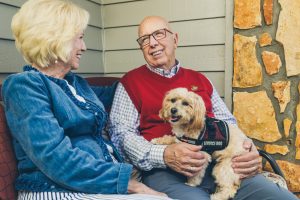
The Horns moved into their apartment in May 2023. After caregiving for Marilyn’s mother, they wanted peace of mind for their children as they aged. They rave about the BTV staff and enjoy the meals, performances, games, parties and the friends they’ve made. They volunteer in the sensory garden and stay active by walking and attending balance class. Derl’s service dog, Gracie, is constantly by his side.
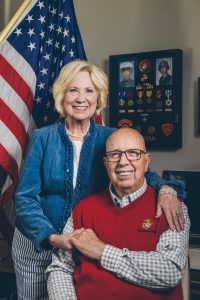
They treasure the retreat of their home, where she likes to knit, crochet and bake sourdough bread. During the COVID pandemic, she also started painting watercolors and learned to play piano. In frequent phone and video calls with their children and five grandchildren, they catch up and take prayer requests. For Derl’s 70th birthday, Marilyn created a shadow box showcasing his military photos and medals.
Derl’s brother served in the Army; Marilyn’s two brothers served in the Marines, and her dad and an uncle served in the Army during World War II. Derl and Marilyn in their own ways understand what it’s like to serve and protect American freedoms. In this year of America’s 250th birthday, they see faith, service and freedom as intertwined parts of their lives.
A few years ago, the couple visited the Vietnam Veterans Memorial in Washington, D.C. The two black granite walls bear the names of more than 58,000 men and women who gave their lives, including 749 Marines from Derl’s battalion. “On section 22E, there are 59 of my brothers killed on July 2 in a battle called Operation Buffalo. It really is an honor to visit, but it’s very difficult,” Derl said. “It’s a reminder that freedom is not free.”
Words by Michelle Parks | Photos by Stephen Ironside


